What is Bitcoin Dominance and How Does It Affect Altcoins?
Introduction
One question that every trader has in mind is: When will Bitcoin pump, and when will Altcoin Season start? When people search for answers, many guides do not explain it properly. They often tell traders to follow altcoin news or check the Altcoin Season Index.
However, the market does not work that way. One of the biggest factors behind Altcoin Season is Bitcoin Dominance. It plays a major role in showing when altcoins may start performing better than Bitcoin. The problem is that many new traders do not even know What is Bitcoin Dominance is or how it works.
In this guide, you will learn everything related to Altcoin Season. We will explain What is Bitcoin Dominance is, how to check whether Altcoin Season is approaching, and many other important concepts. You will also discover useful insights that are often not explained clearly in one place.
What is Bitcoin Dominance?
In simple words, BTC Dominance shows what percentage of the total cryptocurrency market value belongs to Bitcoin alone. It tells us how much of the money in the entire crypto market is currently invested in Bitcoin compared to all other cryptocurrencies.
Let’s say the total crypto market is worth $3 trillion. When we check the BTC Dominance chart, we find that $2 trillion of that value is in Bitcoin. This means the remaining $1 trillion is invested in altcoins. To calculate the exact BTC Dominance percentage, we use a simple mathematical formula.
BTC.D = (Bitcoin Market Cap / Total Crypto Market Cap) × 100
Example:
- Total Crypto Market Cap: $2 Trillion
- Bitcoin Market Cap: $1 Trillion
- BTC.D = 50%
This means that out of every $100 invested in the crypto market, $50 is invested in Bitcoin
What is Altcoin Season?
Many new crypto traders do not know what Altcoin Season is. Bitcoin was the first cryptocurrency ever created. All other cryptocurrencies that came after Bitcoin are called altcoins.
Altcoin Season happens when most altcoins start performing better and increasing in price. A common way to identify Altcoin Season is when around 75% of the top cryptocurrencies (excluding Bitcoin) show stronger growth than Bitcoin over a certain period.
Many people say that when BTC.D (Bitcoin Dominance) goes down, altcoins go up. But this is not always correct. This is a misunderstanding, and many traders fail because of it. I will explain it in a simple way.
You cannot only look at BTC.D and assume that altcoin season has started. It is possible that when BTC.D drops, the money is not going into altcoins. Instead, it may be moving into stablecoins like USDT or USDC.
It is also possible that money goes back into Bitcoin again, or people simply cash out. That’s why you need to look at the full picture before deciding if altcoin season has started or not.
Big whales (large investors) usually follow a clear cycle. First, they buy stablecoins. After that, they use those stablecoins to buy Bitcoin. When money flows from stablecoins into Bitcoin, the Bitcoin price goes up. Then, when Bitcoin reaches a good profit level, whales take profit.
After taking profit from Bitcoin, whales often move their money into altcoins. When money enters altcoins, their prices start pumping. This is how altcoin rallies usually begin.
A very important point is that you should also check stablecoin dominance along with BTC.D. If both BTC.D and stablecoin dominance are going down at the same time, then it is a strong signal that altcoin season may be starting.
Stablecoin dominance is important because it shows where the money is sitting. If whales are holding their money in stablecoins instead of investing it, then altcoins will not rise much. That is why tracking stablecoin dominance is just as important as BTC.D when analyzing the market.
How whales trap retail traders in altcoins
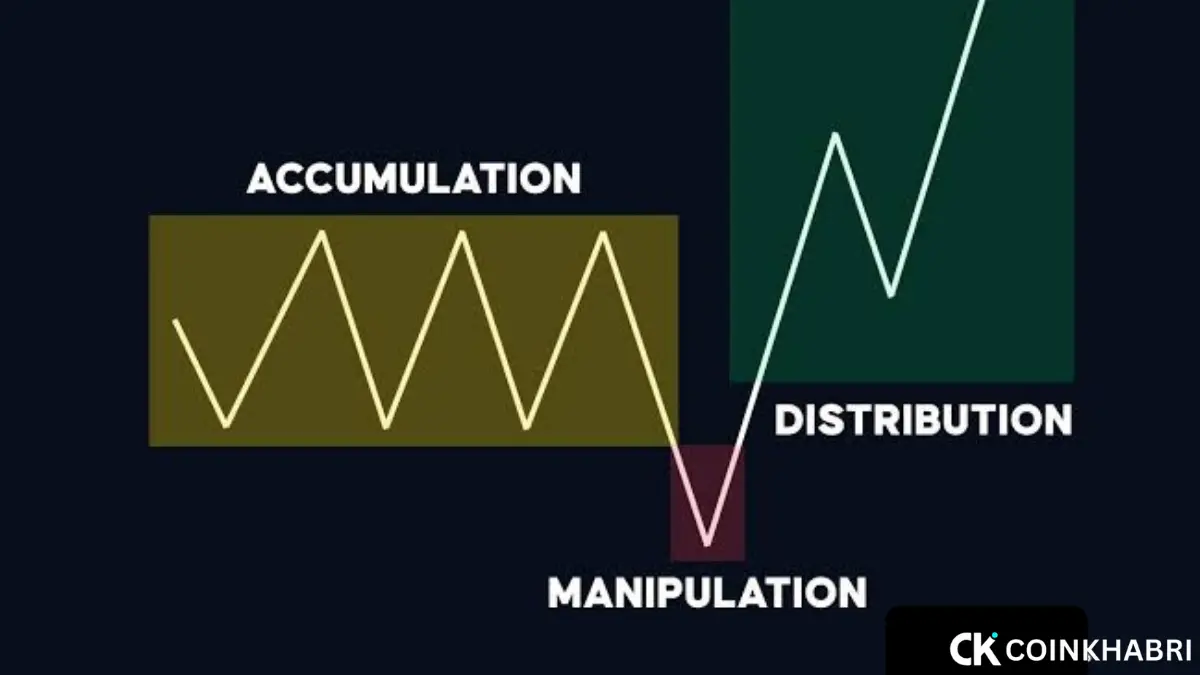
Whales first increase Bitcoin dominance in the market. When Bitcoin reaches a certain level, they start booking their profits. After that, they pull money out of Bitcoin. When money comes out of Bitcoin, Bitcoin dominance starts to fall. Retail traders then see that Bitcoin dominance is going down and altcoins are pumping.
Retailers then start putting their money into altcoins. When a large number of retail traders invest, they believe that altcoin season has started and prices will keep going up.
But when whales see that a lot of money has entered the altcoin market, they start pulling their money out of altcoins and move it back into Bitcoin.
When money flows back into Bitcoin, BTC starts pumping again. Retail traders get trapped because they bought altcoins at high prices, and then the market drops. In this way, whales use market dominance to trap retail investors, leading them to losses.
How to read the BTC Domimnace chart?
To read the BTC dominance chart, first open TradingView and type BTC.D in the search bar. Select the official Binance or TradingView index. After that, a line or candlestick chart will appear in front of you, where you will see percentage levels on the side such as 50%, 55%, 60%, and so on.
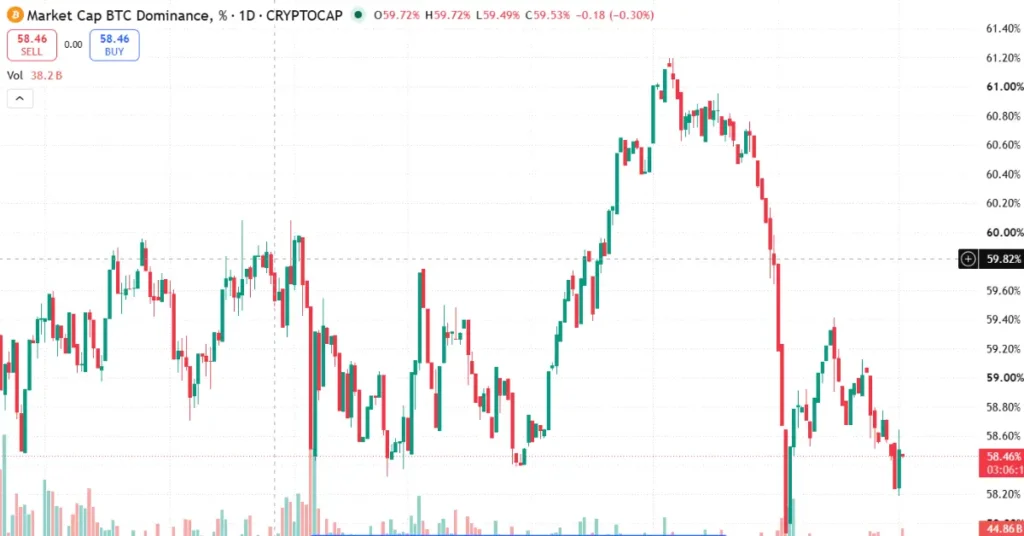
First, check the trend and major support or resistance levels, just like you do in normal technical analysis. If the dominance chart is going up and the candles are holding above the 200-day moving average, it means there is still money flowing into Bitcoin. In this case, an altcoin season has not started yet.
The real advantage comes when you compare this chart with Bitcoin’s actual price movement. If Bitcoin is moving sideways in a range or slowly trending upward, and at the same time the BTC dominance chart starts breaking down quickly, losing a key support level and moving downward, then this becomes a strong confirmation signal that an altseason is coming.
This means that smart money is taking profits out of Bitcoin and rotating that capital into other altcoins.
If you see bearish patterns like a Double Top or Head and Shoulders forming on the dominance chart, then understand that the market balance is about to shift. At that point, you should shift your focus away from Bitcoin and start looking toward strong altcoins.
Risk Management in Altcoin Season
Risk management is very important during Altcoin Season (Altseason). If you don’t manage your risk properly, instead of your portfolio turning green, it can easily turn red. That’s why it is necessary to always follow proper risk management.
The 70-30 Portfolio Rule
Never let greed make you invest 100% of your capital into small coins or meme coins. Instead, always follow the 70-30 rule. In this rule, 70% of your portfolio stays safe in Bitcoin, Ethereum, and stablecoins like USDT, while only 30% is used for high-risk altcoins.
Step-by-Step Profit Taking
Altcoins usually have low liquidity, which is why during market crashes they fall much faster than Bitcoin, sometimes even 5x more. That’s why you should always take profits step by step during every big pump. For example, if any coin goes 2x, take out your original investment and let the profit ride.
Hard Stop-Loss & Liquidity Check
Along with this, always set a hard stop-loss in your system because the crypto market can drop sharply within seconds and wipe out your portfolio with sudden wicks. Also, always check the daily trading volume of low-cap coins so you don’t get trapped during crashes due to low liquidity or high slippage.
Spotting the Top & Retail FOMO
Finally, when you see meme coins pumping 200% daily without any real utility and Bitcoin Dominance (BTC.D) dropping to historical low levels around 35%–40%, understand that retail FOMO is at its peak. At that point, instead of getting greedy, it is better to convert your profits into stablecoins and exit the market.
Suggest: What is Good Crypto Fundamental Analysis & How is it Done?
Conclusion
Bitcoin Dominance and Altcoin Season have a strong connection. It shows how smart money and whales rotate their capital in the market. Never become greedy during an altcoin season and keep booking your profits regularly. Because you never know when the market can suddenly form a long wick and crash your portfolio.