What is Real World Assets RWA and How Can You Invest in It
Just as the value of cryptocurrency is continuously falling day by day, the market of Real World Assets (RWA) is rising, but many people do not know what it is and how to invest in Real World Assets (RWA) In today’s guide, we will discuss this in detail.
Real World Assets (RWA) Tokenization What is it?
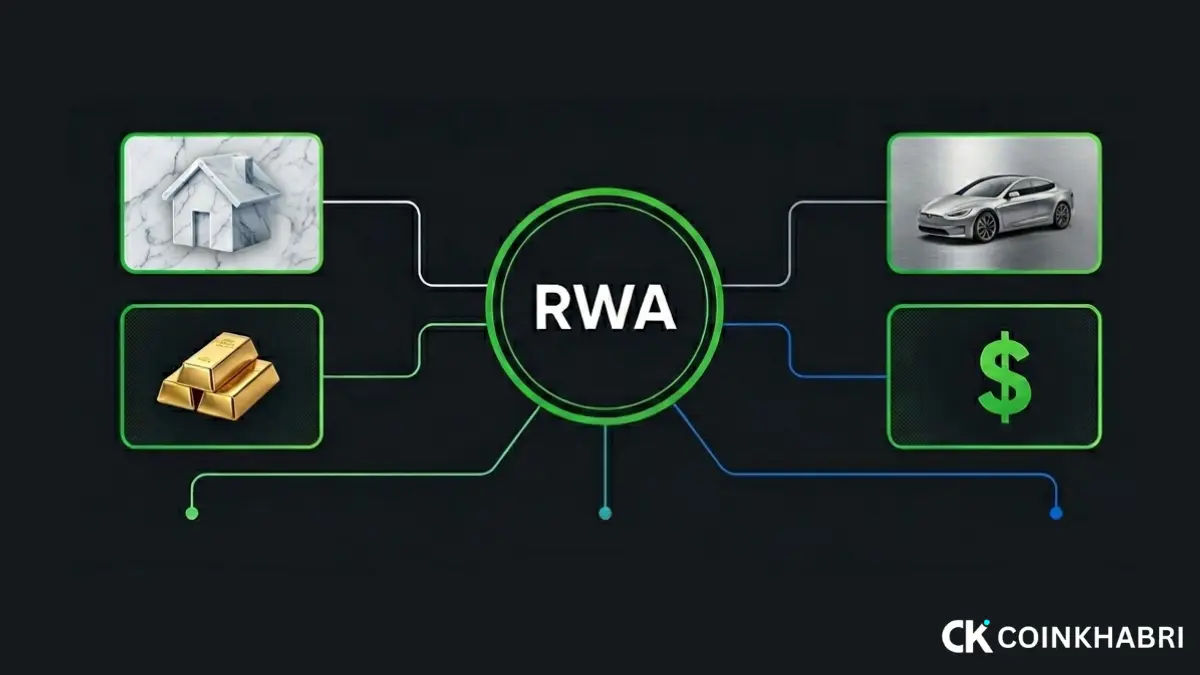
Real World Assets (RWA) Tokenization is a process in which physical or financial real-world assets (such as real estate, gold, bonds, stocks, art) ownership or rights are converted into blockchain-based digital tokens.
Imagine you have a $1 million commercial building. You want to sell it but you don’t find a single buyer. Now think: if you divide that building into 1,000 digital tokens — each token = $1,000 — and list these tokens on the blockchain? Now 1,000 different investors can invest in that building.
How does it work?
Imagine you have a commercial building. First, a government or private institution verifies its ownership to confirm that it belongs to you. Then they research and determine the actual value of that building.
Once all this paperwork is completed, the institution connects that real-world asset to the blockchain. It is linked to the blockchain through oracles. Behind this, programming is done so that the data of this real-world asset comes onto the blockchain.
After this, a token is created for it, and it is not like a normal cryptocurrency token that can be created in two minutes. It uses strong ERC-3643 security behind it. Once the token is created, investors invest in it, and because of this the building gets sold within a few days. The building remains with you, but the ownership is distributed among the investors who have invested in it.
Why Real World Assets (RWA) growing so much?
Its biggest growth reason is that things which used to take years to sell in real life can now be sold in just a few days through tokenization, because they are divided into many small parts and trading continues 24/7.
In 2022, its market cap was 5 billion dollars, but by 2026 it has increased to more than 35 billion dollars. Another reason for this growth is that in Pakistan and other countries, many investors wanted to buy real estate but could not afford it. Now, through tokenization, they can sit in Pakistan or any other country and invest in real estate easily.
What Things Are Being Tokenized?
Now when it comes to real world assets (RWA), a question definitely comes to investors’ minds: which real world assets are being tokenized? Right now, real estate, gold, government bonds, and expensive paintings have been tokenized.
But in the coming times, vehicles may also be tokenized, and it is also being said that by 2030 its market cap could be 4 trillion dollars.
Which Token Standards Are Used for Real World Assets?
Common crypto tokens (like ERC-20 tokens that we use for meme coins or normal trading) are not used in Real World Assets (RWA). Because common crypto is permissionless—any hacker or anonymous person can send it to anyone. To keep Real World Assets (RWA) legal on blockchain, special Security Token Standards are used:
ERC-3643 Standard
This is an institutional RWA standard which locks legal rules and automatic compliance inside the token’s smart contract. In this, every user has an ONCHAINID (digital identity). When an investor sells this token to another person, the smart contract first checks in the registry whether the next wallet is KYC verified or not, and if it is not verified, the transaction is automatically blocked.
ERC-1400
ERC-1400 is a standard. It is specially designed for assets where complex financial operations need to be handled. It has a rule of partially forced transfers, meaning if a court order comes, the administrator can force transfer the token without a private key.
Also, through this standard, a single token can be divided into different parts like equity and debt, and property legal documents can be used cryptographically.
TradFi vs. Tokenized DeFi
Traditional Finance (TradFi) and the Tokenized RWA ecosystem are completely different. In TradFi, trading hours are limited (Monday to Friday, 9 AM – 4 PM), while the RWA ecosystem works 24/7/365 non-stop.
In TradFi, settlement of land or any asset can take days or months, while in RWA it happens within a few seconds through instant atomic settlement.
In the traditional market, minimum investment is from $50,000 to $1,000,000, but in RWA, due to fractional ownership, it can start from just $10 to $100.
In TradFi, middleman fees are very high because of brokers, lawyers, and banks, while in RWA these fees are very low due to smart contracts.
For asset recovery in TradFi, one has to go through banks and long legal processes, while in RWA the token can be recovered on the blockchain by providing legal proof.In terms of transparency, TradFi works on centralized and hidden files, while RWA clearly shows every transaction on a publicly auditable blockchain ledger.
Real-World Case Studies
First major example is BlackRock’s BUIDL Fund. The world’s largest asset management company, BlackRock, is running its BUIDL Fund on the Ethereum network, which tokenizes US Treasury Bills (government bonds). In this, large investors buy BUIDL tokens and the yield (profit) they receive from US government bonds is directly delivered to their crypto wallets every day in the form of new tokens.
Second major example is Franklin Templeton (FOBXX). They have launched their native money market fund on the Stellar and Polygon blockchains. Through this, they have removed the old and expensive methods of the traditional banking system and, using blockchain, reduced their operational overhead costs significantly and are providing better liquidity.
Things about RWA that no one tells
Where there is so much benefit, there are also drawbacks of tokenization. Everyone talks about the benefits, but no one tells that there are some hidden disadvantages as well. I did a lot of research, and only then I found out about the downsides of RWA, which I will explain to you.
The first issue is the Oracle vulnerability and physical risk. Imagine you bought a token of gold, and in the real world that gold is kept in a bank locker. If it gets stolen or there is a fire in that bank, then on the blockchain the token will still look safe, but the physical asset behind it will be gone. That is why heavy insurance is needed.
In RWA, you are forced to trust some third party or custodian who will protect the real-world asset. If that custodian company goes bankrupt, then token holders may have to go through court cases.
Blockchain is borderless, but land and securities laws are different in every country. Europe’s MiCA law brings some clarity, but because of strict rules from the US SEC and other regulators, it is still very difficult for normal retail users to legally invest in big RWA projects.
Complete Method of Investing in Real World Assets (RWA)
There are two different ways to invest in Real World Assets (RWA). The first method is through the general crypto market by buying infrastructure tokens and gold tokens, and the second method is by going on specific Real World Assets (RWA) platforms and buying fractions of real assets (like property). Below is the complete detail of both methods.
Direct Investment in RWA Through Crypto Exchanges
If you already have Binance or any decentralized wallet (like MetaMask), then you can earn profit from Real World Assets (RWA) assets without any complex verification. In this, there are two main types of assets. The first is tokenized gold, and the easiest and safest way is to buy PAX Gold (PAXG), which is a token of Paxos company and is traded on Binance like normal crypto. Each token is equal to a real gold bar stored in London vaults, so when the price of gold increases in the world, the value of your token also increases, and there is no risk of theft in it.
The second type is Real World Assets (RWA) infrastructure tokens, where you invest in tokens of those companies that are running the backend system of RWA. For example, Ondo Finance (ONDO), which is connected with BlackRock’s BUIDL fund and gives yield on US Treasury bills, or Chainlink (LINK), which provides real-world live data to the blockchain. By buying these tokens, you can invest in Real World Assets (RWA).
Investing in Real Estate and Properties Through Official RWA Platforms
If you want to become a partner in a plaza or apartment in America, Dubai, or Europe by investing only 50 or 100 dollars and earn monthly rental income, then the process is different and is handled by big platforms like RealT and Lofty.ai. The step-by-step method is this:
First, you have to go to the official website of these RWA platforms and complete KYC verification by uploading your original ID card or passport. When your identity is verified, you can select any building from their list and buy a small share or token of it for only 50 dollars, and you can make the payment through crypto stablecoins or your bank card.
The rent of tenants living in that building is collected in the real world, and the platform converts that rent into dollar tokens (USDC or USDT) and sends it according to your share directly to your crypto wallet every month.
While direct investment in RWA tokens is efficient, you must always prioritize security in the crypto space. If you are holding digital assets on exchanges or in wallets, make sure you know how to Protect Your Digital Assets to avoid common vulnerabilities.
Conclusion
The RWA tokenization market is growing very fast so big institutional investors are investing in it. BlackRock, JPMorgan, Goldman Sachs, Franklin Templeton — the world’s largest financial institutions are actively investing in it. $35 billion is already on-chain and a $30 trillion potential is being seen.